← Starting solids: the overview
All foods from A to Z
234 foods with a traffic-light colour, sorted alphabetically. Green means well suited, amber means preparation decides, red means not in the first year.
Well suited With limits Not suitable
All 234 foods
45 foods have a page of their own. Their name is a link.
| Food | In short |
|---|---|
| Almond butter | Only as butter, spread thinly. Never whole almonds, a choking risk until about age 4, says the BfR. |
| Almond drink | Fine for cooking into purée. |
| Amaranth | Cook it very soft into a porridge. |
| Apple | Raw hard pieces of apple can break off. Steamed, finely grated or one large piece to gnaw on is safer than cubes. |
| Applesauce (unsweetened) | Plain from a spoon or stirred into porridge, always without added sugar. |
| Apricot | Ripe and stoned, mashed or as a soft half to hold. |
| Artichoke | Only give the soft cooked heart, puréed or mashed. |
| Asparagus | Boiled soft, peeled and puréed, or as a whole soft spear to hold. |
| Avocado | Mashed or as a wedge to hold. |
| Baked beans | From the tin usually sweetened and salted. Choose a low-sugar kind or rinse them, and mash them at first. |
| Banana | Split lengthways to hold, or mashed with a fork. |
| Barley | As a fine porridge from barley flakes, or purée very soft cooked pearl barley. |
| Beans (kidney, white) | Only well cooked through, raw beans contain phasin. Mash them at first. |
| Beef | Always cooked right through. Raw or pink meat is off limits for babies, says Gesund ins Leben. |
| Beetroot | Cooked soft and puréed, in small amounts and only now and then. |
| Bell pepper | Steamed soft and peeled, as finger-length strips or puréed. |
| Biscuits / “baby biscuits” | Even baby biscuits are often a sugar trap, so read the ingredients list. Sugar-free rusks or strips of bread are the honest choice. |
| Blackberries | Mashed or as a whole soft berry. |
| Blueberries | Small and round. Squash or halve them at first. |
| Bok choy | Soft-steamed and finely puréed or chopped into rice. |
| Bread | The soft inside or soft crust as strips to suck on. |
| Broccoli | A soft-steamed floret to hold. |
| Brussels sprouts | Cooked soft and puréed, just a small amount at first. |
| Buckwheat | Cook it soft and purée it into a fine porridge. |
| Butter | Stir a small knob into the vegetables. |
| Buttermilk | Stir a few spoonfuls into porridge or purée. |
| Butternut squash | Peeled and cooked soft, as a purée or as a finger-length wedge. |
| Carrot | Raw carrot is hard and snaps easily. In the first year cook it soft or grate it finely. |
| Cashew butter | Stir a thin layer into the purée. |
| Cauliflower | A soft-steamed floret on its stalk to hold, or puréed. |
| Celery | Cooked soft and puréed, in a small amount. |
| Celery stalks | Pull off the long strings and cook it soft. Raw, the stalks are hard and stringy. |
| Chard | Freshly cooked and finely puréed, in small amounts and only occasionally. |
| Cheddar | Finely grated over the purée, a small amount. |
| Cheese (sliced) | Only pasteurised cheese. Raw milk cheese is off limits for babies, says Gesund ins Leben. Strips, not cubes. |
| Cherries | Stone and quarter lengthways. Cherries are round like grapes. |
| Chia seeds | They swell a lot. Always soak them first, give at most about a teaspoon and plenty of liquid. |
| Chickpeas | Offer them cooked soft and mashed. Whole chickpeas are round and firm. |
| Chocolate / cocoa | Sugar plus caffeine traces, not needed in year one. The later the start, the longer it stays special. |
| Chocolate hazelnut spread | Mostly sugar and fat. Pure nut butter gives the nuts without the sugar trap. |
| Chocolate sprinkles (hagelslag) | The Dutch bread classic is pure sugar. Not needed in the first year, and happily longer than that. |
| Cinnamon | Sparingly and ideally Ceylon. Cheaper cassia cinnamon contains coumarin, which the BfR says toddlers tolerate only in small amounts. |
| Coconut (flakes/milk) | Stir coconut milk into purée or curry. |
| Coconut water | Not needed, water is the drink. |
| Coffee / cola / energy drinks | Caffeine has no place in babyhood or the toddler years. That includes cola, iced tea and energy drinks. |
| Cooked ham | A tiny amount of cooked ham, finely chopped into the purée. |
| Corn | Single kernels are small and smooth. Mash them at first or serve as polenta. |
| Corn cakes | As a big piece to suck on, unsalted. |
| Cornflakes (unsweetened) | Soaked in milk and mashed, unsweetened. |
| Cottage cheese | Choose a low salt kind. |
| Couscous / bulgur | Very soft and swollen, mixed with a little veg purée so it doesn't crumble. |
| Cow's milk | Drinking only towards the end of the first year, at most about 200 ml a day from a cup, says Gesund ins Leben. In porridge earlier is fine. |
| Cranberries | Fresh they are very sour, firm and round, so halve them. Dried ones are usually sweetened like sweets. |
| Cream (for cooking) | Stir a spoonful into the vegetables. |
| Cream cheese | Stir a little into the vegetables or spread it thinly on a strip of bread. |
| Cress | A few leaves finely chopped and sprinkled over the food. |
| Crispbread | Can break into hard splinters. Only once chewing is safe, and then thinly spread. |
| Croissant / pastry | As a rare exception the soft inside in strips. |
| Cucumber | Peeled, deseeded and as a finger-length stick to suck on. |
| Currants | Small and round, so mash them at first. They are quite sour and go well in cereal or compote. |
| Custard / pudding | Ready-made vla and pudding are sweetened. Unsweetened yoghurt with fruit purée is the baby version. |
| Dates | Always pit them and cut them small. And go easy, dates are almost pure sugar. |
| Dragon fruit | Ripe and peeled, mashed or as a soft wedge. |
| Dried fruit (sulphured) | Sulphured fruit contains sulphites, a major allergen that can irritate. Choose unsulphured, cut small and sparingly, it is full of sugar. |
| Duck | Only cooked all the way through. Remove the fatty skin for your baby. |
| Dumplings | Cook it soft and mash it, or hand over a piece to suck on. |
| Edamame | Round and smooth like peas, so shelled, cooked soft and mashed at first. Soy is a major allergen. |
| Egg | Only fully cooked, so hard boiled or baked through. No soft or raw egg in the first year. |
| Eggplant | Stewed or baked soft and puréed, with the skin removed. |
| Elderberries | ONLY cooked through, as juice or compote. Raw elderberries are not tolerated and cause nausea. |
| Fennel (vegetable) | Steamed soft as a purée or a finger-length wedge. |
| Feta / sheep's cheese | Very salty. Soak it in water first and only add a few crumbs. Buy pasteurised feta. |
| Figs | Fresh, ripe and peeled. |
| Fish fingers | As an exception, that works. |
| Flaxseed (ground) | Ground only, no more than half to one teaspoon, and with plenty of liquid. Whole seeds pass through undigested. |
| Fruit pouch | Not for constant sucking. Fruit sugar washes around the teeth, and nobody practises chewing. Better squeeze it onto a spoon. |
| Garlic | A tiny amount cooked in and finely crushed into the purée. |
| Ginger | A hint cooked into the food. |
| Gnocchi | Cook them soft and halve them for holding, or mash them. |
| Goat cheese (pasteurised) | Only from pasteurised milk. Raw milk kinds are off limits for babies. |
| Goat's milk | Like cow's milk. As a drink only towards the end of the first year, and only pasteurised. With a cow's milk allergy it is NO way out, because of cross-reactions. |
| Gooseberries | Round with a tough skin. Halve them or mash them. |
| Grapefruit | Segments without membranes, mashed and in a tiny amount. |
| Grapes | According to the AAP, whole grapes are one of the most common causes of choking. Always quarter lengthways, halving across is not enough. |
| Greek yogurt | A spoonful plain or with fruit purée, but only now and then. |
| Green beans | Only cooked right through. Raw green beans contain phasin, which is not tolerated. |
| Green spelt | As a fine green spelt porridge that you cook nice and soft. |
| Guacamole | Without salt from a spoon or spread thinly on a strip of bread. |
| Hazelnut butter | Stir a thin layer into the purée. |
| Herbs & mild spices | Finely chopped and cooked in, a small amount. |
| Herring | Only cooked through. Matjes and Bismarck herring are raw cured and off limits for babies, pickled herring is also very salty. |
| Honey | Honey can contain botulism spores and is off limits for the whole first year, says the BfR, even in traces and even boiled. Surprisingly many people do not know that. |
| Hummus | Homemade and without salt, from the spoon or spread thinly on a strip of bread. |
| Ice cream | Sugar, plus a germ risk with soft serve. Puréed frozen fruit is the baby version for teething. |
| Jam | Mostly sugar, and WHO and DGE advise none under the age of two. Use mashed fruit on bread instead. |
| Juice | Babies need no juice, lots of sugar, bad for coming teeth. If at all, heavily diluted with meals. |
| Kale | Braised soft and finely puréed, a small amount at first. |
| Kefir | A few spoonfuls plain or stirred with fruit purée are enough. |
| Kiwi | Ripe and peeled, mashed or as a soft wedge to hold. |
| Kohlrabi | Raw it is hard and snaps easily. In the first year only cooked soft. |
| Lamb | Lean meat, cooked right through and finely puréed in the vegetable purée. |
| Lamb's lettuce | Not raw yet. |
| Leaf lettuce | Raw, smooth leaves stick to the palate. Offer them only once chewing is reliable, cut into narrow strips. |
| Leek | Stewed soft and finely puréed, only the pale part. |
| Lemon / lime | A squeeze into the food is enough. |
| Lentils | Cook red lentils until they fall apart into a purée. |
| Linseed oil | Half a teaspoon cold over the finished purée. |
| Liver | Cooked through and finely puréed, only now and then and in small amounts. |
| Lupin flour / products | A small amount baked in or stirred into purée. |
| Lychee | Round, smooth and slippery like a grape, with a big stone. Pit it and quarter it lengthwise. |
| Mackerel | Cooked through, deboned and finely mashed into the purée. |
| Mango | Ripe and peeled, mashed or as a wedge. |
| Maple syrup | It is and stays sugar, and WHO and DGE say none under two. Ripe fruit sweetens porridge just as well. |
| Margarine | A small knob stirred into the vegetables. |
| May turnip | Cooked soft as purée or as a finger-length wedge. |
| Meatballs | Without salt and cooked well through. |
| Melon | Ripe and seedless as a finger-length stick to suck on, or mashed. |
| Mild spices (curry, cumin) | A pinch of mild spice cooked into the food. |
| Millet | As a fine purée, soft-cooked, happily with fruit purée. |
| Millet rings | One at a time to suck on, they dissolve in the mouth. |
| Mirabelle plum | Small, round and with a stone. Pit them and quarter them. |
| Mozzarella | Mini balls are round and slippery like grapes, so quarter them lengthwise. Only from pasteurised milk. |
| Mushrooms | Only serve mushrooms cooked right through, never raw. |
| Mussels | Only fully cooked through and cut small, mussels are chewy. Molluscs are a major allergen. Discard any that stay closed. |
| Mustard | A hint of mild mustard stirred into the sauce or meatball. |
| Napa cabbage | Steamed soft and finely puréed, or chopped and mixed into the purée. |
| Nashi pear | Peeled and steamed as a purée or soft wedge. |
| Nectarine | Ripe, without skin or stone, mashed or as a soft wedge to hold. |
| Nut butter (mixed) | Stir a thin layer into the purée, that is plenty. |
| Oat drink | Fine for cooking into porridge. |
| Oats | Fine oats, soaked soft in liquid and served as porridge. |
| Okra | Braised soft and puréed. |
| Olive oil | A teaspoon stirred into the vegetables. |
| Olives | Always pit them and quarter them lengthwise, they are round. Soak them well, olives are very salty. |
| Omelette / scrambled eggs | Let it set firmly. Runny scrambled egg is still half raw and off limits in the first year. |
| Onion | Cooked along and finely puréed in the vegetable purée. |
| Orange / mandarin | Segments without membrane, mashed or as a whole segment to suck on. |
| Other edible mushrooms | Only cultivated mushrooms and only cooked through. Self-picked mushrooms are off limits for babies. |
| Pancakes | Bake it without sugar, cook it through and cut it into finger length strips. |
| Papaya | Ripe, peeled and deseeded, mashed or as a wedge. |
| Parmesan | Very salty, just a touch over the food. Classic Parmesan is a raw milk cheese, to be safe choose pasteurised hard cheese. |
| Parsley root | Cooked soft as a purée or as a finger-thick stick. |
| Parsnip | Cooked soft as a purée or a finger-thick stick. |
| Passion fruit | Push the pulp through a sieve and stir it, seed free, into fruit purée. |
| Pasta | Cooked very soft, big grippable shapes like fusilli or penne, whole. |
| Peach | Ripe, without skin and stone. |
| Peanut butter | Only spread thinly or stirred into purée, thick blobs stick to the palate, warns the AAP. With eczema, check with a doctor first, advises the S3 guideline. |
| Peanut puffs (e.g. Bamba) | Unsalted, softened in breast milk or water and mashed. |
| Pear | Ripe and soft as a wedge to hold. |
| Peas | Small and round. Boil them soft and mash them lightly at the start. |
| Persimmon | Only fully ripe and jelly soft. |
| Pesto | Shop-bought is very salty, with raw-milk parmesan. Home-made without salt and with ground nuts is the baby version. |
| Physalis | Small and round. Always quarter it. |
| Pineapple | Ripe and without the core, finely puréed or as a large piece to suck on. |
| Plain yogurt | Plain whole milk yoghurt from the spoon or stirred with fruit purée. |
| Plum | Ripe and stoned, mashed or as a soft half. |
| Pointed cabbage | Braised soft and finely puréed, a small amount at first. |
| Polenta | Cooked creamy as porridge or cooled as a finger-length stick to hold. |
| Pollock | Cook it through and mash it finely into the purée. |
| Pomegranate | Small, round and firm. At first only the squeezed juice in cereal, whole seeds only once chewing is safe. |
| Popcorn | A choking risk, warns the AAP. The hard, light pieces are easily inhaled. Unsuitable for babies and toddlers. |
| Pork | Only cooked right through. No raw mince and no raw pork spread, says Gesund ins Leben. |
| Porridge / muesli (unsweetened) | Cook it fine and soft, with some fruit purée if you like. |
| Potato | Boiled soft as the base of the purée or as a large soft wedge to hold. |
| Poultry | Always cooked right through. Raw poultry can contain salmonella. |
| Pretzel | Rub off the coarse salt, lye pastry is salty. Soft pretzel arms are the most baby friendly form. |
| Pumpkin | Cooked soft as a purée or a finger-length wedge. |
| Pumpkin seed butter | Stir a thin layer into the purée, that is plenty. |
| Quark | A spoonful of whole milk quark stirred with fruit purée, only now and then. |
| Quince | Raw, it is rock hard. Only offer it cooked soft as a compote or purée. |
| Quinoa | Rinsed thoroughly, cooked very soft and stirred into veg purée. |
| Rabbit | Cook it through, carefully pick out every bone splinter and purée it finely. |
| Radishes | Hard, round and peppery. In the first year only finely grated or not at all. |
| Raisins | Soak them and purée them, and only now and then. |
| Rapeseed oil | Stir a teaspoon of rapeseed oil into every vegetable purée, it belongs there. |
| Raspberries | Mashed or as a whole soft berry. |
| Raw-milk cheese | Raw milk and its cheese are off limits for babies. They can carry listeria, says Gesund ins Leben. |
| Rhubarb | Only cooked, and because of the oxalic acid only occasionally. Raw rhubarb is not suitable for babies. |
| Rice | According to the BfR, rice can contain traces of arsenic. Alternate with other grains, no rice porridge every day. |
| Rice cakes | Handy, but the BfR advises restraint because of possible arsenic levels. Only now and then, not as a daily snack. |
| Rice drink | Unsuitable for babies and toddlers, the BfR warns of arsenic. No substitute for breast milk or formula. |
| Rice noodles | Cooked very soft, cut small and mashed. |
| Rice pudding (unsweetened) | Cook it without sugar, fruit purée instead of cinnamon sugar. Like all rice, alternate it and not daily, the BfR warns of arsenic. |
| Ricotta | Pasteurised, a spoonful stirred into vegetables or with fruit purée. |
| Rusk | Softens quickly in the mouth, which is why babies love it. Many kinds contain sugar though, so choose a sugar free one. |
| Rye | As a fine porridge from rye flakes, well soaked. |
| Salmon | Only cooked through. Raw fish is off limits for babies, smoked salmon too. Remove every bone. |
| Salt / very salty foods | Baby purée stays unsalted, says Gesund ins Leben, the kidneys are not ready yet. Leave out salty snacks and stock cubes too. |
| Salt sticks | Pure salt, just as the name says. Unsuitable in the first year, the kidneys are not ready for it yet. |
| Sardines | From the tin in oil and finely mashed into purée. |
| Sausage | Always halve or quarter round sausages lengthwise, the AAP advises. Sausage is salty, offer it only rarely. |
| Savoy cabbage | Braised soft and finely puréed, a small amount at first. |
| Seitan | Pure wheat protein, meaning gluten, and shop-bought often heavily seasoned and salty. Offer it unseasoned and cut soft. |
| Shrimp | Only fully cooked and cut small, shrimp are rubbery. Shellfish are a main allergen. |
| Skyr | A spoonful stirred with fruit purée, and only now and then. |
| Smoothie | Home-blended from fruit and veg from a spoon is fine. As an all-day drink too much fruit sugar, and shop-bought ones are often sweetened. |
| Sour cherries | Just like cherries. Pit them and quarter them lengthwise. |
| Soy drink | Fine for cooking into purée. |
| Soy yogurt (unsweetened) | Unsweetened from a spoon or with fruit purée, just a small amount at first. |
| Spaetzle | Cooked soft and mashed, or hand over single soft spaetzle to hold. |
| Spanish tortilla | Only when fully set. A runny centre is raw egg and must not be liquid for a baby. |
| Spelt | As a fine porridge from spelt semolina or flakes, soaked soft. |
| Spelt sticks | One stick to suck and gnaw on, without sugar and without salt. |
| Spinach | Freshly cooked and finely puréed, in small amounts and only now and then. |
| Sprouts | Raw off limits for babies, the BfR warns of germs up to EHEC. Heated through in the pan they are fine. |
| Squid | Rubbery and chewy, so hard to chew. Only braised very soft and cut fine. Molluscs are a major allergen. |
| Strawberries | Mashed or cut into thin slices. |
| Sugar & sweets | No added sugar under age 2, say the WHO and DGE, and no sweetened pouches or biscuits either. Hard sweets are a choking risk on top. |
| Sugar snap peas | Steamed soft and with the strings removed, as a whole pod to hold or puréed. |
| Sunflower seed butter | Stir a thin layer into the purée. |
| Swede / rutabaga | Cooked soft as a purée or as a finger-length wedge to hold. |
| Sweet potato | Cooked soft as a purée or a finger-length wedge. |
| Tahini (sesame paste) | Stirred thinly into the purée, a small amount at first. |
| Tempeh | Steamed and finely mashed, or as a soft strip to hold. |
| Toast | Lightly toasted in finger length strips. |
| Tofu | Soft tofu mashed, or as a finger-length strip to hold. |
| Tomato | Cherry tomatoes are round like grapes. Always quarter them lengthways. |
| Tomato sauce (passata) | Stirred without salt into purée or pasta sauce. |
| Tortilla / wrap | Soft and cut into finger-length strips, thinly spread with purée. |
| Trout | Only cooked through, and debone it very carefully. Trout have lots of fine bones. |
| Tuna | Big predatory fish like tuna accumulate mercury, so only rarely for babies. Better choose salmon, pollock or trout. |
| Unsweetened tea | Unsweetened and lukewarm from a cup, only now and then. |
| Vanilla | A little real vanilla seed stirred into porridge. |
| Veggie mash (stamppot) | Without salt and mashed fine, then it is a purée. |
| Venison | Cook it through and purée it finely into the vegetable mash. |
| Waffles (unsweetened) | Unsweetened, baked soft and cooked through. |
| Water | A few sips from an open cup with meals. |
| Watermelon | Remove the seeds. At first cut out the small white ones as well. |
| Wheat / semolina | As a fine semolina porridge, cooked soft. |
| White / red cabbage | Braised soft for a long time and finely puréed, a small amount at first. |
| White bean spread | Without salt from a spoon or spread thinly on a strip of bread. |
| White fish (e.g. cod) | Only cooked through, and remove every bone first. |
| Whole nuts | Whole nuts are THE classic choking cause, off limits until about age 4, say the BfR and AAP. As butter or finely ground they are absolutely fine. |
| Zucchini | Steamed soft as a purée or a finger-length stick. |
Sources: WHO and UNICEF on texture stages, ESPGHAN 2017 on the lumpy-food window in months 8 to 10.
This page gives general information and does not replace medical or dietetic advice. Every child develops differently. When in doubt, talk to your paediatrician or a registered dietitian.
The ages are rough guides. What counts is not the calendar but what your child can already do with mouth and hands.
The five safety rules
- Quarter round food lengthwise. Grapes, cherries and cherry tomatoes never go on the plate whole.
- Cook hard food soft or grate it finely. Raw carrot and raw apple break into hard pieces otherwise.
- Nuts are never whole, only as a butter or finely ground.
- Eating happens sitting upright, never lying down and never on the move.
- Stay with your baby while they eat. Choking happens silently.
Sources: AAP, the German BfR and Netzwerk Gesund ins Leben. All dangerous foods at a glance
All 234 foods in the app
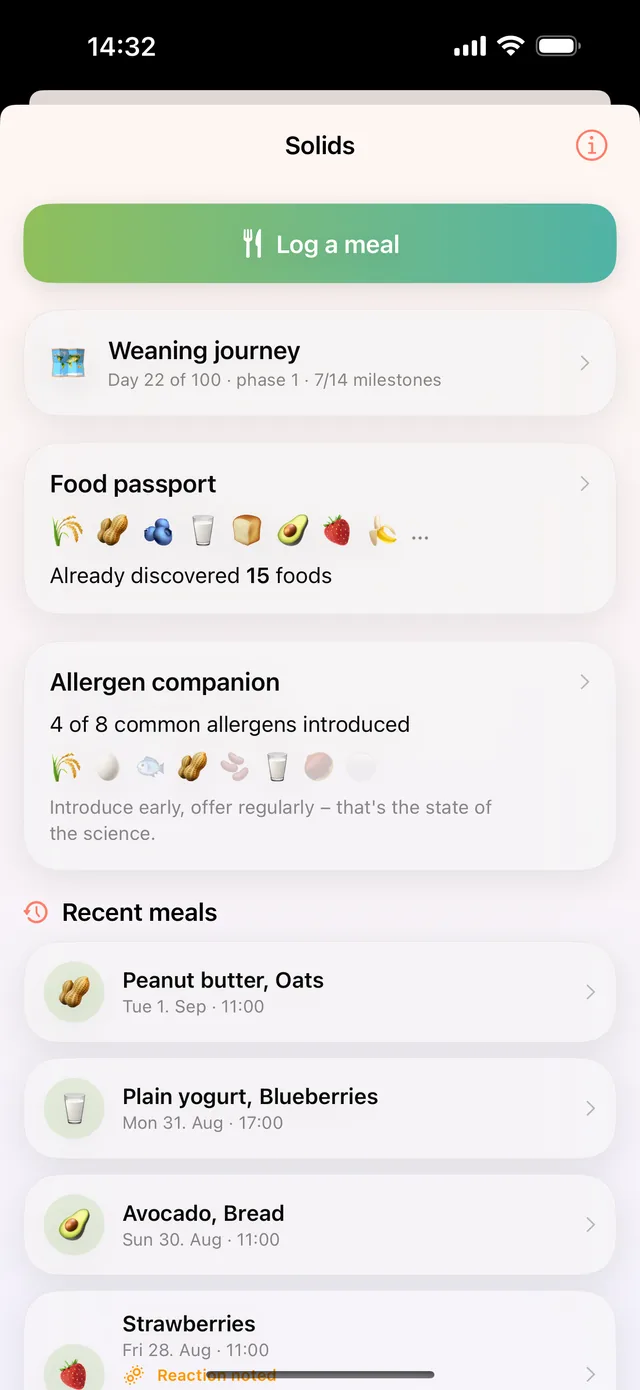
HeyFini shows the preparation that fits your own child's age, plus the food passport and the allergen companion for all 14 main allergens.

Common questions
How many foods are in this list?
234, all from the checked catalogue inside the HeyFini app. Each one carries its traffic-light colour and the core in one sentence.
What do the colours mean?
Green means well suited and fine from the start of solids. Amber means allowed, but the shape or the amount decides. Red means not in the first year.
Why doesn't every food have its own page?
45 foods have a full page with the preparation for 6, 9 and 12 months. For all the others the core is here in the list, and the full preparation by age lives in the app.
Where do these statements come from?
From the app's food catalogue. It leans on the German BfR, Netzwerk Gesund ins Leben, the AAP, WHO, UNICEF, ESPGHAN and the S3 guideline on allergy prevention.

Read on
- What can my baby eat at 6 months?
- Finger food from 9 months: what works?
- Foods that are dangerous for babies
- Starting solids: the overview
- When to start solids: the 5 readiness signs
- What foods should babies not eat?
- Introducing allergens: early beats late
- Solids plan: the first 100 days
- Iron in your baby's diet
General guidance, not medical advice. For questions about your child, talk to your paediatrician or midwife. In an emergency call your local emergency number (112 in the EU, 999 in the UK, 911 in the US).